
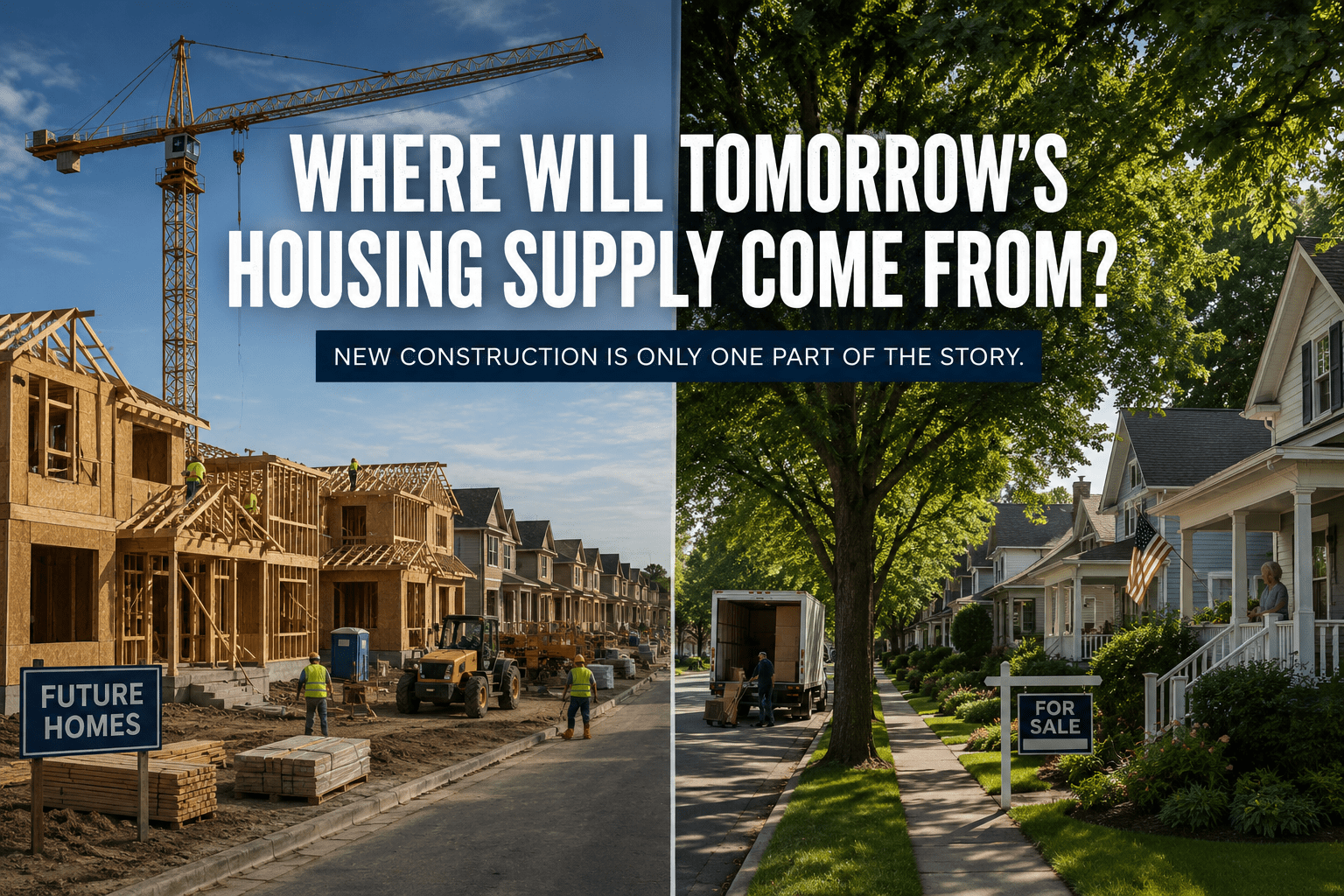
Everyone Is Talking About Housing Supply. They're Asking the Wrong Question.
New construction matters—but many of tomorrow's listings won't come from builders. They'll come from homeowners experiencing major life transitions.

A new federal housing initiative has renewed the national conversation about one of real estate's most pressing challenges: increasing housing supply. The 21st Century ROAD to Housing Act aims to encourage new construction, expand financing opportunities, support manufactured housing, and make homeownership more attainable for millions of Americans.
Those are worthwhile objectives. More housing inventory can improve affordability, expand buyer choice, and help relieve pressure in markets that have struggled with limited supply.
Whether new legislation alone will produce a meaningful increase in available housing, however, remains to be seen. Building homes is rarely as simple as passing a law. Developers continue to navigate labor shortages, rising material costs, higher financing expenses, permitting delays, infrastructure demands, and local zoning restrictions. Even under the most optimistic scenario, planning, approving, financing, and constructing new housing is measured in years—not months.
That doesn't diminish the importance of increasing supply. It simply recognizes that expanding the nation's housing stock is a long-term objective rather than an immediate solution. In the meantime, another source of housing inventory continues to reshape local markets every single day.
Existing homeowners.
More specifically, homeowners whose personal circumstances—not the broader real estate market—lead them to sell.
Every day, families experience life events that fundamentally change their housing needs. A death in the family. A divorce. An inheritance. Retirement. Downsizing. Financial hardship. An aging rental property. A vacant home that has become more of a burden than an asset.
These life transitions create motivated sellers regardless of whether mortgage rates are rising or falling—or whether new housing legislation ultimately delivers the hoped-for increase in inventory. That distinction matters.
While policymakers debate how to build more homes, successful real estate professionals understand that many opportunities originate from existing homes changing hands—not because they are newly built, but because their owners have reached an important transition in life.
This is where predictive real estate intelligence changes the conversation.
Rather than waiting for a property to appear on the MLS, forward-thinking agents and investors seek to identify homeowners whose circumstances suggest a future real estate decision may be approaching. Publicly available transition signals—such as probate filings, inherited property, divorce proceedings, long-term vacancy, absentee ownership, and pre-foreclosure activity—can provide valuable insight long before a listing becomes public.
The goal is not simply to be first. It is to provide meaningful guidance when homeowners are evaluating significant life decisions and may benefit from knowledgeable, professional assistance.
New construction will always play an important role in addressing America's housing shortage. But it is only one source of tomorrow's inventory.
Long after today's legislation is forgotten, families will continue to inherit homes, retire, relocate, downsize, separate, and adapt to changing financial circumstances. Those life transitions will continue to create opportunities for real estate professionals who understand that behind every property is a person—and behind many sales is a story.
For agents looking to build a more consistent pipeline of business, perhaps the better question isn't:
"How many homes will be built?"
Instead, ask:
"Which homeowners are most likely to need my guidance before everyone else knows they're ready to move?"
At The Areté Group, we believe the best opportunities rarely begin with a listing. They begin with understanding the life transitions that ultimately create one. To identify off-market opportunities in your backyard, get in touch.