
The Violation Isn't the Opportunity
Why savvy investors and agents look beyond the citation itself—and focus on the story behind it.

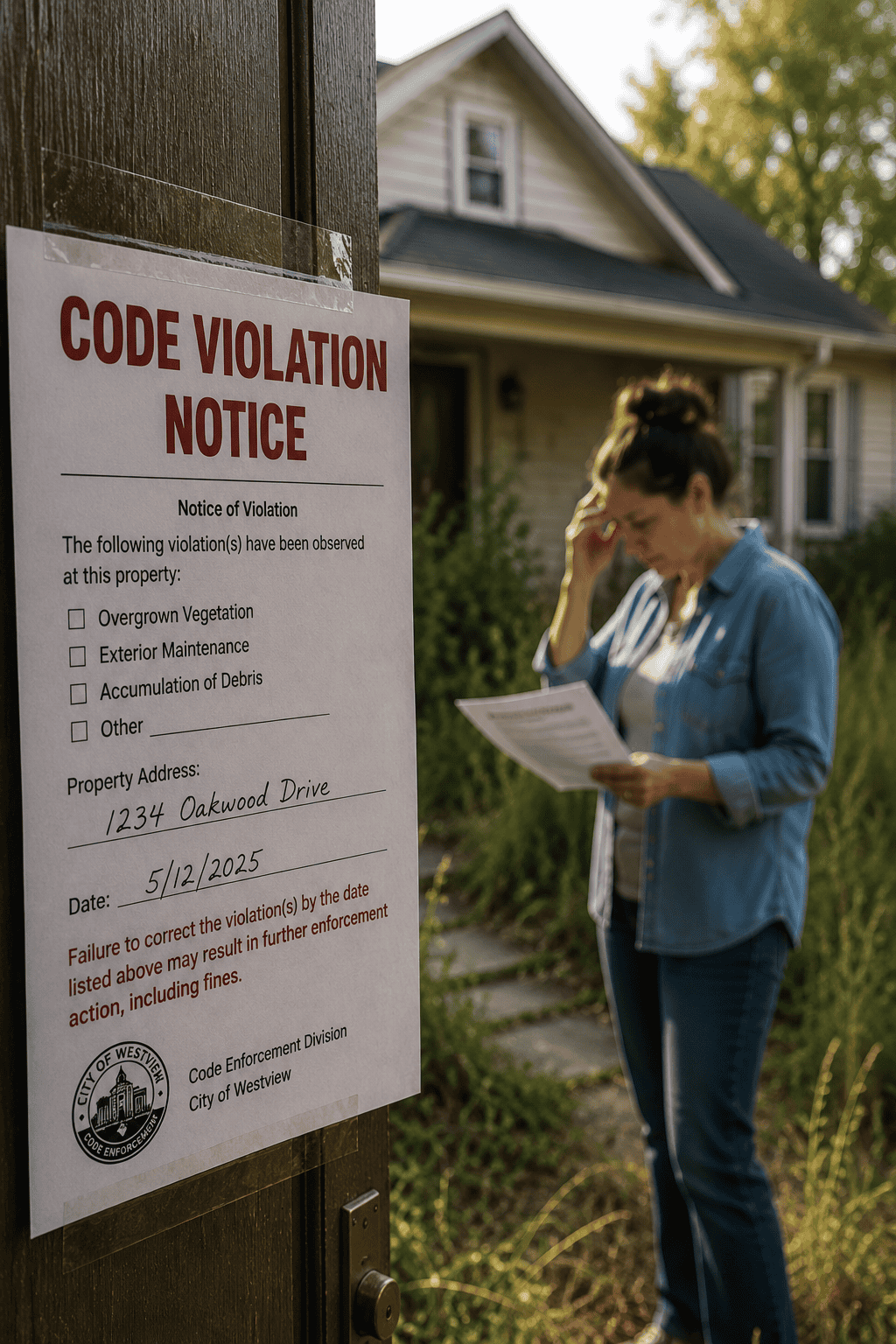
Most people see a code violation and think of peeling paint, overgrown vegetation, a broken fence, or a property owner who forgot to pull a permit.

Experienced real estate practitioners often see something else. They see a signal.

Code violations rarely appear in a vacuum. In many cases, they are symptoms of larger circumstances affecting a property owner. An aging owner may no longer be physically capable of maintaining the property. An absentee owner may have lost visibility into conditions on the ground. A family may have inherited a property they never intended to own. Financial hardship may have forced maintenance to the bottom of the priority list.

The violation itself is not necessarily the opportunity. The story behind the violation often is.


Not Every Code Violation Matters

Before discussing why some investors actively seek out properties with code violations, it is important to acknowledge an obvious point: many violations are completely insignificant.


A homeowner may receive a notice because the lawn became overgrown while they were on vacation. A rental property owner may be cited because a tenant failed to bring trash containers in from the curb. A homeowner may have installed a fence, water heater, or shed without realizing a permit was required.

These situations may result in a citation, but they do not necessarily indicate seller motivation, financial distress, or a forthcoming real estate transaction.

This distinction is important because many novice investors and agents assume every code violation represents an opportunity. In reality, many are quickly corrected and never become anything more than a temporary inconvenience.

The question is not whether a property has a code violation. The question is why.

Looking Beyond the Citation

The most successful investors rarely focus on the violation itself. Instead, they look for clues about the circumstances that may have created it.


Consider a property owned by an individual who has lived in the home for forty years. Deferred maintenance begins to accumulate. The city issues notices regarding vegetation, exterior conditions, or safety concerns.

The issue may not be the property. The issue may be that the owner is aging and can no longer maintain it.

Likewise, an absentee owner who lives hundreds of miles away may struggle to keep tabs on a rental property. A code enforcement notice may simply be the first visible sign that ownership has become more burdensome than anticipated.

Inherited properties frequently present similar challenges. Heirs often inherit a home they do not want, do not occupy, and may not be financially prepared to maintain. Deferred maintenance and code issues are often symptoms of a much larger transition already underway.

In each of these examples, the violation itself is not the story. The owner's circumstances are.

Why Investors Pay Attention

Code violation data tends to resonate more strongly with investors than with traditional real estate agents.


Investors are often equipped to solve the very problems that generated the violation in the first place. Deferred maintenance, property cleanup, rehabilitation, permitting issues, and repositioning projects are frequently part of their business model.

Agents, by contrast, generally prefer homeowners who have already begun contemplating a sale. A code violation does not necessarily mean an owner is motivated to sell. In many cases, the owner simply corrects the issue and moves on.

That does not mean code violation data lacks value for agents. It simply means the violation should not be viewed as a standalone lead source. Instead, it is often most useful when combined with other indicators that suggest a larger ownership transition may be occurring.

Viewed through that lens, a code violation becomes less of a lead source and more of a clue.


The Power of Multiple Signals

This is where many real estate professionals get into trouble. They become fixated on a single piece of information. Sophisticated prospectors know better. 

A code violation by itself may mean very little. However, when combined with other indicators, a more compelling picture can emerge. Consider the following examples:

  • A vacant property with multiple maintenance citations.
  • An inherited property with deferred maintenance violations.
  • An absentee owner receiving repeated code enforcement notices.
  • A long-term owner facing both property upkeep issues and tax delinquency.

Individually, each data point may be unremarkable. Together, they may suggest an owner confronting challenges that could eventually lead to a sale. The best opportunities are often discovered not through a single event, but through the accumulation of signals.

A Practical Challenge

Another reality often goes unmentioned when discussing code violation data: scale.
 

Many real estate professionals prefer to focus their prospecting efforts close to home. Probate, divorce, inherited property, absentee owner, and vacant property campaigns can often generate meaningful opportunities within a relatively small geographic area.

Code violations can be different. Serious violations that potentially indicate ownership fatigue or distress tend to occur less frequently and are often dispersed across a much larger area. An investor targeting an entire metropolitan region may find enough opportunities to justify a campaign. An agent hoping to generate listings within a single neighborhood may not.

For that reason, code violation data is often best utilized as a supplemental indicator rather than a standalone marketing strategy.

Marketing to Owners with Code Violations

One of the biggest mistakes investors and agents make is allowing the violation itself to become the marketing message.

Nobody wants to receive a postcard announcing that their property appears distressed. The code violation, then, is intelligence for the marketer—not necessarily a conversation starter for the owner. Successful outreach tends to focus on the circumstances that may have led to the issue rather than the issue itself.

An aging owner may respond to discussions about downsizing and simplifying responsibilities. An absentee owner may be interested in alternatives to long-distance property management. An heir may appreciate guidance regarding inherited real estate.

In other words, the most effective marketing speaks to the owner's situation, not the municipal citation.

The best investors understand that they are not really marketing to code violations. They are marketing to people.


The Bigger Lesson

Perhaps the biggest lesson is that successful prospecting rarely begins with a single data point.

A code violation may tell you something about the property, but it tells you very little about the person who owns it. The most effective real estate professionals look beyond the citation and focus instead on the circumstances that may have caused it.

The opportunity is rarely the peeling paint, the overgrown lawn, or the municipal notice taped to the door.

The opportunity is understanding the story behind it. At Areté, we have long believed that real estate opportunities emerge from life transitions. Whether the signal is probate, inheritance, vacancy, absentee ownership, or even a code violation, the principle remains the same.

Transitions leave clues. The key is knowing where to look.