
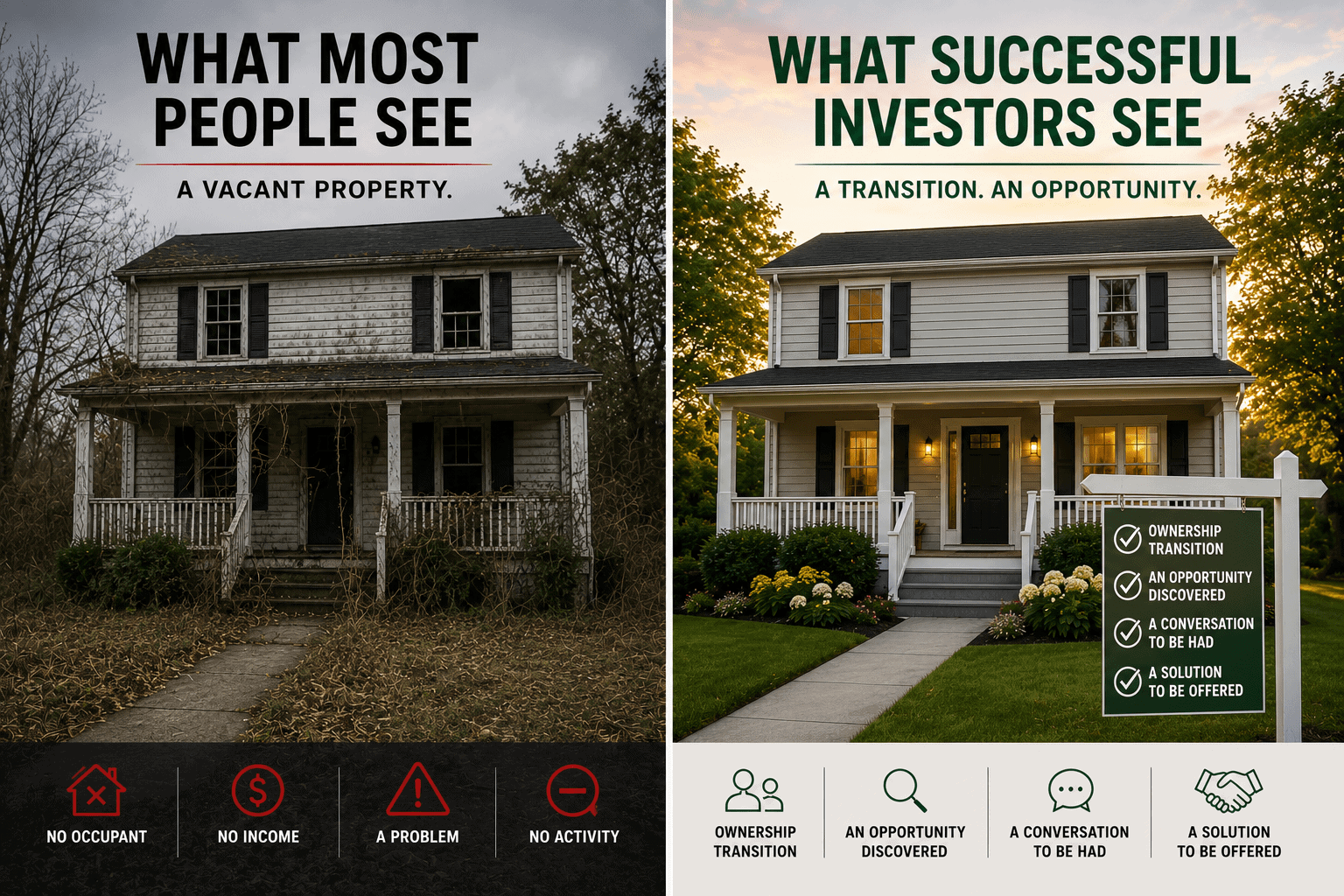
Vacancy Is a Signal, Not a Strategy
What 1.4 Million Vacant Homes Reveal About Hidden Real Estate Opportunities

ATTOM, a leading provider of property data and real estate intelligence solutions, recently reported that approximately 1.4 million residential properties across the United States sit vacant despite persistent housing shortages and affordability challenges. While many investors focus on inventory constraints, the findings highlight a different reality: a substantial number of homes remain underutilized even in a market where demand continues to outpace supply.
For real estate professionals, the more important question is not how many homes are vacant, but why they are vacant in the first place. The answer often has less to do with the property itself and more to do with the owner's circumstances.
Behind many vacant homes is a family facing an important decision. An inherited property, a move to assisted living, a divorce, a relocation, or a landlord preparing to retire can leave a home sitting empty while owners weigh their next steps. Vacancy is rarely the root issue. More often, it is a symptom of an ownership transition.
The most successful investors understand this distinction. They do not simply target vacant properties. They seek to understand the people and situations behind them.

The Bigger Story Behind Vacancy
While recent housing data highlighted a relatively small number of so-called "zombie foreclosures," the far more significant takeaway is that nearly 1.4 million homes remain vacant nationwide. Many of these properties are not distressed.
Some are inherited homes caught in probate. Others are former rentals awaiting repairs or disposition. Some belong to absentee owners who have relocated, while others are tied to family transitions that make immediate decisions difficult.
Vacancy does not necessarily indicate financial distress. It often indicates uncertainty. And uncertainty frequently creates opportunity for real estate professionals who know how to approach owners with solutions rather than sales pitches.
"A vacant property tells us what happened. Understanding the owner helps explain why it happened."
Not all vacant property leads represent opportunities
One of the biggest mistakes investors make is assuming every vacant property owner is motivated to sell. Some owners are actively renovating. Others may be holding property for future use, waiting for family circumstances to change, or simply choosing not to occupy the home.
Vacancy alone is not a motivation indicator. The goal is not to find empty houses. The goal is to identify property owners experiencing a meaningful transition that may require action.
That distinction can dramatically improve prospecting efforts and reduce wasted outreach.
The cost of doing nothing
Many vacant property owners are not making a conscious decision to keep a property empty. Instead, they are postponing a decision altogether. Meanwhile, the costs continue to accumulate.
Even a mortgage-free property may carry:
- Property taxes
- Insurance premiums
- Utility expenses
- Lawn and exterior maintenance
- Security concerns
- Code enforcement risks
- Deferred maintenance costs
Over time, an underutilized property can become both a financial burden and a source of stress. Many owners understand this. What they often lack is a clear path forward.

Why Vacant Property Owners Finally Take Action
The most effective investors and agents rarely begin a conversation by discussing a purchase price. Instead, they seek to understand the owner's situation.
Questions such as:
Do you intend to keep the property long-term?
Are repairs preventing you from moving forward?
Is the property tied to an inheritance or probate matter?
Have you considered renting the property?
What challenges are preventing you from making a decision?
often reveal motivations that are not apparent from public records alone.
The objective is not to convince someone to sell. The objective is to help them evaluate their options. When owners gain clarity, action often follows.
A vacant property owner may ultimately decide to sell. Another may choose to renovate and rent. Someone else may transfer the property to a family member or pursue an entirely different strategy. The common thread is that movement usually occurs once uncertainty is replaced with a clear path forward.
Why Context Matters More Than Vacancy
A vacant property tells us what happened. The ownership data helps explain why. That is why sophisticated investors increasingly look beyond vacancy alone and combine it with other indicators such as:
Probate filings
Inherited ownership
Absentee ownership
Long-term ownership
Pre-foreclosure activity
Aging ownership demographics
Tax delinquency
Deferred maintenance indicators
Viewed independently, each data point offers limited insight. Viewed together, they can reveal an ownership transition long before a property ever reaches the market.
The Best Real Estate Practitioners and Investors Solve Problems
The most successful investors do not see vacant properties as transactions. They see them as situations.
A vacant home may represent an heir struggling to settle an estate. A landlord may be exhausted from years of property management. A family may be navigating a move, a divorce, or the transition of a loved one into long-term care.
In each case, the real opportunity is not the property itself. It is the ability to help an owner move forward. The investors and agents who consistently uncover off-market opportunities are often those who approach property owners as problem solvers first and transaction participants second.
Parting Thoughts
The latest vacancy trends confirm that a substantial number of residential properties remain underutilized across the country despite strong housing demand. But vacancy, by itself, is only an observation. The real opportunity lies in understanding the ownership transitions that often create a vacancy in the first place.
The most successful real estate professionals do more than identify empty houses. They identify the people behind them, the circumstances they are facing, and the solutions they may be searching for.
Vacancy isn't the opportunity. Understanding the story behind the vacancy is.

ABOUT
At The Areté Group, we help real estate professionals move beyond simple property lists by identifying the ownership transitions that often create opportunity in the first place. By combining vacancy data with probate filings, inherited property records, absentee ownership, and other predictive indicators, investors and agents can focus less on chasing addresses and more on helping property owners navigate important decisions.
To learn how transition-based data can help you uncover off-market opportunities before they become widely visible, get in touch.